
Wake County Court Records After a Jail Arrest
The court-records-after-arrest path in Wake County is separate from the custody path. A person may be arrested, transported to the Wake County Detention Center, reviewed by a magistrate, and listed in the Sheriff's Police-to-Citizen system before every court entry is visible online. The criminal case belongs to the North Carolina Judicial Branch, not the jail. That court record can show the defendant's name, county, case number, hearing dates, charge text, charge level, disposition, and whether the matter is in district court or superior court.
Use Wake County jail inmate records when the immediate question is whether someone is still in custody, what facility holds them, or what bond appears on the jail roster. Use Wake County jail mugshots for the separate booking-photo and county arrest-photo issue. Use court records after a jail arrest when the question is what charges the District Attorney filed, whether the charges were amended or dismissed, what court date is scheduled, and how the case ended.
How to Find Wake County Court Records After an Arrest
The local starting point is the NC Judicial Branch Wake County court page. It links to court dates and criminal calendars. The statewide NC Judicial Branch services page points users toward the Portal for court records and hearing-date searches. Wake's court page says court dates can be searched by name, citation number, county, and related filters. For a jail arrest, select Wake County when the portal or calendar tool offers a county filter.
| Search Field | How It Is Used | Wake County Note |
|---|---|---|
| Name | Searches court dates or case records by defendant or party name. | Use the exact spelling from Wake P2C when starting from a jail arrest. |
| Citation number | Finds traffic, misdemeanor, or citation-linked matters when a number is available. | Useful when a jail or court record lists a citation rather than a full case number. |
| County | Filters statewide court data to the local jurisdiction. | Select Wake County for arrests booked through Wake custody or Wake court. |
| Case number | Looks up a specific docket or file. | Run docket numbers from P2C or paperwork as separate searches. |
| Attorney / party / portal filters | Additional filters vary by NC Judicial Branch portal screen. | Follow the live portal prompts because eCourts features can vary by case type. |
- Start with the Wake Sheriff's P2C Inmate Inquiry and write down the exact name spelling, arrest date, primary charge, bond entries, and any docket or case number shown.
- Open the NC Judicial Branch Portal or Wake court-date link and search by defendant name with Wake County selected.
- If P2C lists a citation number or case number, run that number as a separate search because spelling differences can hide a matching court record.
- Open the matching case and compare the court charge list to the jail charge list. A booking charge can be a starting label, while the prosecutor's formal charge may be amended, reduced, indicted, or dismissed.
- Check Wake criminal calendars for scheduled court sessions when the portal shows a case but the next hearing is unclear.
- For certified copies, older files, disposed cases, expungement questions, or unclear online results, use the Wake Clerk contact channels listed by the Judicial Branch.
The Wake court portal and court-date tools are not the same as a statewide criminal-history report. North Carolina public-record laws make many court filings and returned charging documents public, but a consumer background check has separate legal rules and should not be treated as a casual portal search.
Wake Clerk Contacts for Post-Arrest Court Records
The NC Judicial Branch Wake County contact directory is the right source for current clerk routing, because criminal cases can split between district court, superior court, traffic, misdemeanor, felony, disposed-case, driver-license, and expungement desks.
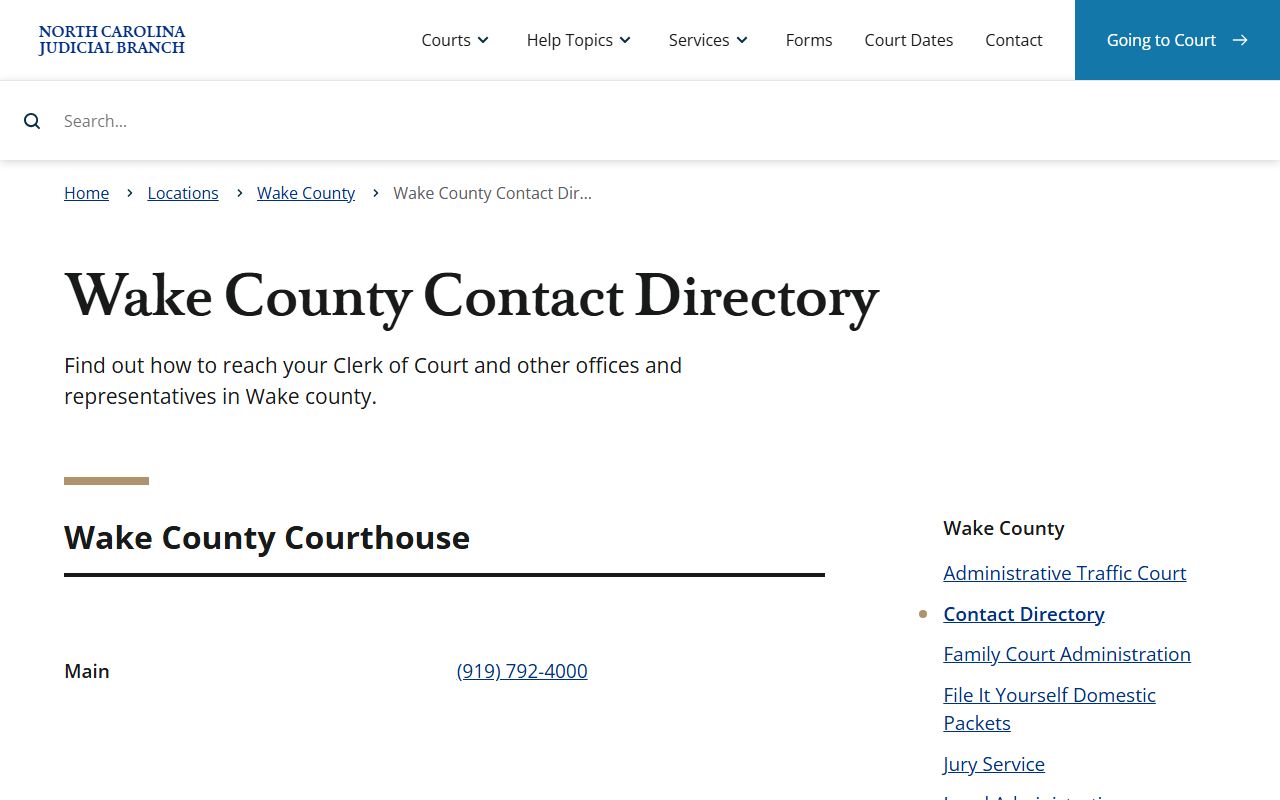
The directory gives these useful criminal-case channels: Clerk of Superior Court at 919-792-4000; Traffic Tickets and Misdemeanors, District Court at 919-792-4300; Felonies, Superior Court at 919-792-4300; and Record Checks, Expungements, Driver's Licenses, Disposed Case at 919-792-4325. Wake County's criminal court work is routed through the downtown Raleigh court complex, but office locations and counter routing should be checked on the live Judicial Branch Wake County page before travel.
District Attorney Review After a Wake County Arrest
Wake County is Prosecutorial District 10. The North Carolina Conference of District Attorneys lists Lorrin Freeman as District Attorney for Wake County, with phone 919-792-5000, fax 919-792-5001, and mailing address Wake County District Attorney's Office, PO Box 31, Raleigh, NC 27602. The official District 10 page is published by the Conference of District Attorneys.
The District Attorney decides how criminal charges proceed after an arrest. Jail roster charges are arrest and booking information. Formal court charges may be filed, amended, reduced, dismissed, indicted by a grand jury, or resolved through plea, trial, or another disposition. Victim notification can also involve NC SAVAN/VINE where available, while victim/witness services in a criminal case route through the prosecutor's office.
Charging Documents After a Wake County Arrest
After a Wake County jail arrest, the charging document is the bridge between custody records and court records. North Carolina public access law treats returned warrants, indictments, criminal summonses, and similar court-filed materials differently from nonpublic criminal-investigation records. The exact document depends on the offense type, the stage of the case, and whether the matter moves from district court to superior court.
| Document | Who Uses It | What It Does | Wake Lookup Note |
|---|---|---|---|
| Warrant for arrest | Judicial official and law enforcement | Authorizes an arrest based on alleged criminal conduct. | May appear as a case or charge source once returned to court, unless sealed. |
| Criminal summons | Court and law enforcement | Orders a defendant to appear without an immediate custodial arrest. | Can create a court record even when no jail booking occurred. |
| Order for arrest | Court | Often follows a missed court date or violation and directs law enforcement to take the person into custody. | P2C sample data showed failure-to-appear related entries with secure bonds and docket numbers. |
| Indictment | Grand jury and prosecutor | Moves or formalizes felony allegations, usually in superior court. | A felony arrest can later show a different superior-court posture after indictment. |
Charge Status in Wake County Court Records
Charge status can change after the jail booking. A person might be booked on a failure-to-appear charge tied to an older docket, arrested on a new offense that has not yet caught up in the court portal, or held while the prosecutor decides whether to amend the charge. Compare each jail entry to each court entry rather than assuming the first roster label is the final case outcome.
| Status | Meaning in a Court Record | Why It Matters After an Arrest |
|---|---|---|
| Pending / awaiting trial | No final disposition has been entered. | The case is still active, and bond, calendars, and next court dates can change. |
| Amended | The prosecutor or court changed the listed charge. | The court record may no longer match the exact booking charge. |
| Reduced | The final or current charge is less serious than the original allegation. | Look at the latest court entry before describing the charge level. |
| Dismissed | The charge ended without a conviction on that count. | A dismissal is not the same as automatic removal from every public system. |
| Convicted / guilty / responsible | The case reached an adjudicated outcome, depending on case type. | This is the point where a charge becomes a conviction or responsibility finding. |
| Expunged | A court expunction order removed public entries for eligible records. | Public systems should not continue displaying the expunged arrest, charge, or conviction entry. |
Bond Terms From Wake P2C After a Jail Arrest
Wake County's official Detention Center page says all bail bonding occurs at the Wake County Detention Center, 3301 Hammond Road, Raleigh. The live Wake P2C sample record inspected during research showed total bond amount and charge-level fields named BondType, BondStatus, and BondAmount. Sample terms included SECURE BOND, SECURE BOND - 2ND OR SUBSEQUENT FTA ON THIS CASE, and PENDING - WAITING TO SEE MAGISTRATE.
| Release Term | Practical Meaning | Wake County Caution |
|---|---|---|
| Written promise to appear | The defendant promises to appear without posting money up front. | Recent violent-crime release restrictions are policy-sensitive; verify current rules with court or counsel. |
| Unsecured bond | No upfront payment, but money may be owed after failure to appear or violation. | A later court event can change the condition. |
| Secured bond | Money, property, or a surety/bondsman arrangement is required for release. | P2C may list secured bond separately for each charge. |
| Cash bond | Cash is posted to satisfy the secured bond. | Confirm the exact amount at the jail or with the magistrate before travel. |
| Surety bond | A commercial bondsman or qualified surety posts the bond. | Commercial surety bonds are separate from the court case record. |
| No bond / hold / pending magistrate | The person cannot be released yet or awaits a judicial release decision. | Another warrant, agency hold, ICE detainer, probation issue, or transfer can block release. |
Warrants, Orders for Arrest, and Court Records After Arrest
No official Wake County Sheriff's active-warrant public search was confirmed in the project research. The Wake P2C app has generic modules for wanted persons and most wanted information, but the observed public navigation emphasized Event Search, Inmate Inquiry, Residential Security Check, Sex Offenders, and Commendation / Complaint. Treat Wake warrants as a court, sheriff phone, or public-records issue unless a current official warrant module is confirmed.
An arrest warrant starts with an alleged offense. A bench warrant or order for arrest often follows a missed court date or violation. A search warrant is different because it authorizes a search or seizure, and returned search warrants are court records under G.S. 132-1.4(k) unless sealed. A fugitive, out-of-county, out-of-state, probation, parole, state, federal, or immigration hold can keep someone in custody even when the Wake charge has a bond amount.
If a warrant has already resulted in a jail arrest, the Wake P2C roster may show the person, charge, court date, docket number, and bond or hold detail. For court-issued orders and failure-to-appear matters, use the NC Judicial Branch Portal, Wake criminal calendars, and the Wake criminal contacts at 919-792-4300. For returned warrants or public arrest information not online, use Wake County NextRequest, subject to sealing and G.S. 132-1.4 limits.
Charges vs. Convictions in Court Records After Arrest
A Wake County arrest and a Wake County conviction are not the same thing. The arrest is the event that brings a person into custody or starts the criminal process. The charge is the accusation shown in the court case. A conviction is a later adjudicated outcome after plea, verdict, or other qualifying disposition. Any public description should preserve that difference.
| Point of Comparison | Charge | Conviction |
|---|---|---|
| Stage | Accusation after arrest or charging document. | Final adjudicated result after plea, verdict, or judgment. |
| Proof Level | Based on probable cause or charging review. | Requires the legal standard for guilt or responsibility in court. |
| Where Seen | Jail roster, warrant, citation, summons, indictment, or court portal. | Disposition or judgment entries in the court record. |
| Can Change | Yes, it may be amended, reduced, added, or dismissed. | It may be appealed, corrected, or expunged if legally eligible. |
Sealed vs. Expunged Wake Court Records After an Arrest
North Carolina law separates ordinary public access from sealed records and expunged records. G.S. 132-1.4 makes criminal investigation and intelligence records nonpublic by default, while allowing public access to specified arrest information and returned charging documents unless sealed. G.S. 15A-153 explains the effect of expunction and the goal of clearing public entries of arrests, charges, and convictions that have been expunged.
| Point of Comparison | Sealed | Expunged |
|---|---|---|
| Public Visibility | Hidden from ordinary public access by court order or rule. | Public entries are cleared under an expunction order. |
| Underlying Event | The record may still exist but access is restricted. | The person may generally treat the expunged matter as not required to disclose in many contexts. |
| Wake Routing | Ask the Clerk or court for access rules on the specific file. | Use the Wake record-check, expungement, driver-license, and disposed-case contact at 919-792-4325. |
| Limits | Sealing does not erase every agency memory of the event. | Expunction does not automatically remove copies from every noncounty website or private database. |
Public Access Rules for Wake Court and Arrest Records
G.S. 132-1 defines North Carolina public records broadly, including documents, photographs, recordings, and electronic data made or received in public business. G.S. 132-6 requires custodians to allow inspection and provide copies as promptly as possible, and it says a requester cannot be required to disclose motive. G.S. 132-1.4 separates nonpublic criminal-investigation and intelligence records from public arrest information and public returned warrants, indictments, and criminal summonses unless sealed.
That distinction explains why a Wake Sheriff's custody record, a CCBI arrest-photo record, a Judicial Branch court file, and a prosecutor's charging decision may not all appear in the same place. A court record after a jail arrest can be public while an investigative file remains nonpublic. A dismissed charge can remain visible unless it is sealed or expunged. A pending case can have public calendar entries while some supporting law-enforcement material is withheld.
Background Check Considerations
Portal searches, P2C lookups, public-record requests, and informal name searches are not the same as a legally compliant consumer report. Employers, landlords, insurers, lenders, and other regulated users must follow the Fair Credit Reporting Act and any other applicable screening rules instead of relying on a casual court-record lookup.
Important: This website is not a consumer reporting agency, and its information may not be used for FCRA-covered decisions.
Restricted Court Records After an Arrest in Wake County
Some post-arrest records are not fully public. Juvenile matters, sealed filings, expunged records, active investigative material, and some sensitive documents can be restricted. Returned search warrants, indictments, warrants, and criminal summonses may be public under G.S. 132-1.4, but that public access has a sealing exception. When the portal does not show what the jail roster suggests should exist, call the Wake Clerk criminal contacts, check criminal calendars, and consider whether the case is too new, sealed, disposed under a different number, or connected to another county or agency.